Bitter: what it is, history, how it is made and how to drink it

What is bitter?
In modern culture, the term "bitter" is used to refer to a number of different alcoholic beverages with a strength of 6 to 50 degrees. They include both some brands and entire types of tinctures, liqueurs, vermouths and even beer. There are also non-alcoholic bitters, of which Schweppes is a prominent representative.
All these drinks have some common denominator. It is about their inherent bitterness, which is obtained as a result of the use of certain plant components in their preparation: herbs, leaves, stems, roots, fruits, seeds and even bark. Actually, the word "bitter" in German and English means nothing more than "bitter".
The most famous bitters:
Martini bitters
Peppercorn
Stark
And a number of other bitters...

The history of the bitter
The practice of using bitter herbal additives in the manufacture of alcoholic beverages was known in ancient times. Take bitter beer, popular among the Nubians who lived in the territory of modern Sudan, or the ancient Greek prototype of vermouth, whose creation is attributed to the famous physician Hippocrates.

However, the history of modern alcohol-based bitters began around the 12th century, a few decades after the appearance of "{banner_adsensetext}" or, more simply, ethyl alcohol.
Educated Benedictine monks from southern Italy were the first to appreciate the medical potential of the new substance. It was here, in one of the monasteries on the outskirts of Salerno, that the first bitter medicinal alcohol tincture appeared, which included berries and cones (berries) of the juniper growing nearby.
Medieval monks perceived bitters exclusively in a medical context. Bitter and bitter decoctions created by them were prescribed for serious diseases of the gastrointestinal tract, commonplace digestive problems, or in case of colds of varying degrees of complexity. Therefore, it is not surprising that even such popular alcoholic beverages as Riga balm и Becherovka were originally created exclusively for medical use.
About four more centuries passed before in 1533 a mixture was made in France, which even today could be unmistakably and unconditionally classified as a bitters. The only, but very significant difference was that in those distant times such drinks should have been sought not in the shop of a wine merchant, but in a pharmacy.

New horizons opened up for the creators of bitters as a result of their acquaintance with the healing properties of numerous representatives of the plant kingdom of the New World. As a result, it appeared to be present today in any self-respecting bar Angostura (the most famous banner in the world).
Interestingly, due to their disinfectant qualities and ability to effectively quench thirst, bitters became an integral part of the diet of European immigrants who settled in tropical and equatorial colonies.

Starting in the second quarter of the XIX century, bitter mixtures prepared on an alcohol basis began to appear in restaurants and drinking establishments. The next quite predictable step was the creation of bitters, initially focused on the restaurant business. The first such drink was the Italian Campari, which appeared in 1904.
In the following decades, the fashion for the production of alcoholic beverages belonging to the category of bitters spread to Italy and neighboring France. Today, bitters, which are more or less popular, are produced in dozens of countries around the world.
How bitters are made?
Beer and wine-based bitters
Everything is quite simple here. The degree of bitterness of beer is mainly determined by the amount of hops added during the brewing process. The level of bitterness of vermouth depends on the ratio of herbs included in the water-alcohol tincture that is combined with wine.
Alcohol-based bitters
There are several variants of the base itself. It can be either grain or grape alcohol, as well as cane or even potato alcohol (according to experts, the latter is used in the Danish Gammeldansk Bitter Dram).
As for the herbal ingredients that give this or that bitters its uniqueness, there are indescribably many of them: from traditional wormwood and gentian to lemon peel and exotic honeysuckle bark.
Bitters based on alcoholic fruits and juices
In addition, bitters are often made with alcoholic fruit and berry juices or fruit drinks, which usually give the name to the corresponding drink (Bitter Lemon, Bitter Cherry, Bitter Peach, etc.).д.).
Depending on the amount of ingredients used, bitters can be divided into simple and complex (multi-component). A classic example of the first option is the textbook one Zubrowka, A typical representative of the second group is Riga balsam.
The main stage of making alcohol bitters
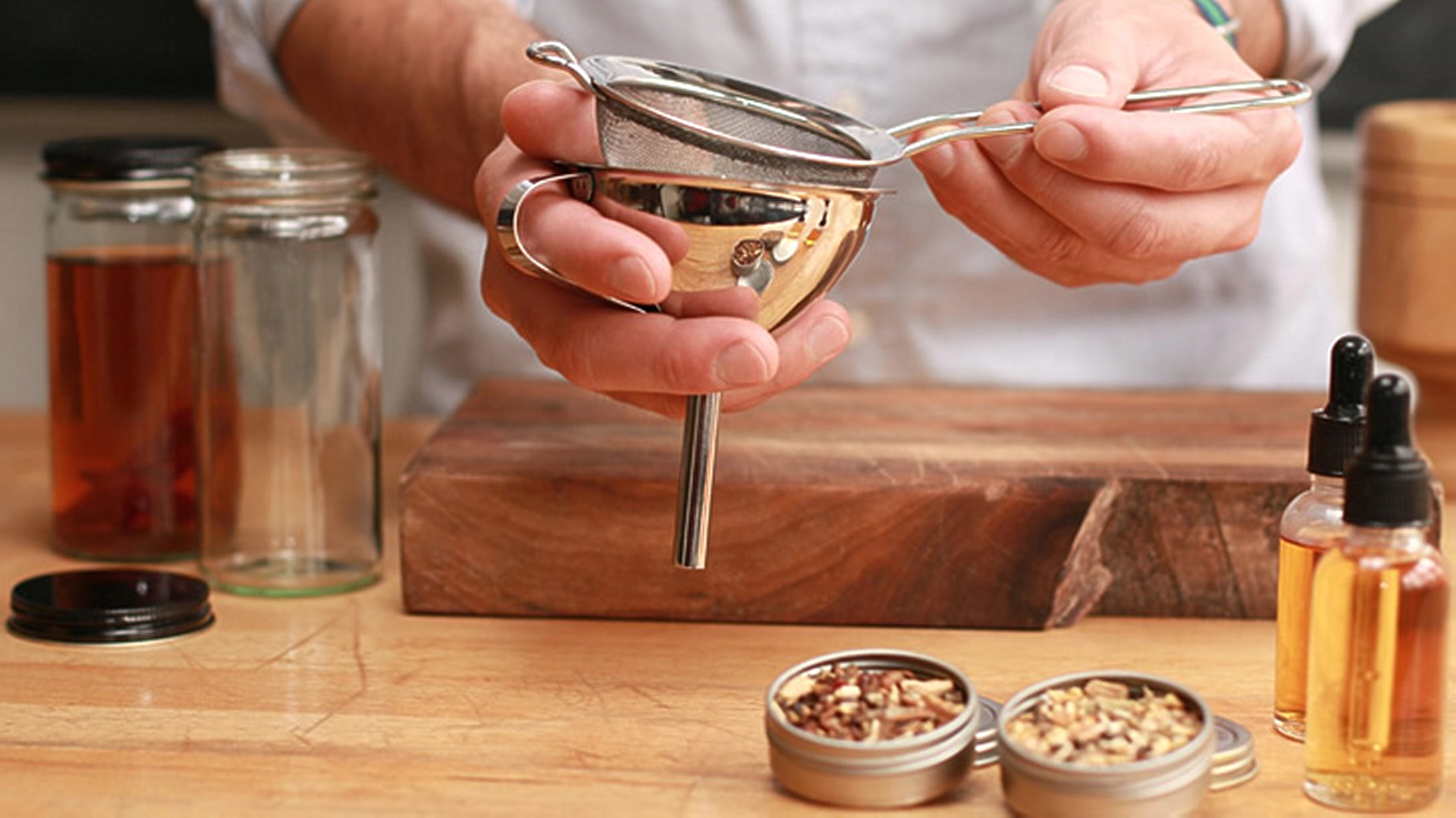
It is called the Latin term "maceration". This is nothing more than the infusion of the necessary components of the future drink on alcohol. The process can take from several days to several weeks.
However, producers of the most unpretentious bitters often do without it, simply adding various concentrates and essences to the water-alcohol solution.
Then the resulting alcohol tincture is filtered and diluted with water to the proper strength. At this stage, as a rule, the belonging of the drink to the number of liqueurs or tinctures is determined. In the first case, caramel, sugar, or sugar syrup is added to the bitters, while in the second case, it remains unsweetened.
Quality bitters are aged from several months to a year.
At the same time, medium-sized drinks mature in containers made of glass or stainless steel, while more aristocratic representatives of the world of bitters, such as Becherovka or Jägermeister, spend this time in oak barrels.
In addition to the above, some bitters are subjected to additional filtration and distillation.
How and when to drink bitters?

The culture of bitters consumption is largely determined by their medical background. In particular, these drinks make excellent digestives and aperitifs due to their digestive properties. At the same time, the temperature of consumption of different representatives of this group of alcohol varies from room temperature to ice cold.
Also, keeping in mind the anti-cold use of bitters, they are often used as a warming agent, consumed both in pure form and added to tea or coffee.
In addition, bitters are popular components of various cocktail mixes and cocktails. Here, we can talk about both banal mixing with beer or tonic and multi-stage constructions. Most often in the cocktail role are such drinks as Jägermeister, Campari и Becherovka.
In conclusion, it is impossible not to mention the wonderful restorative effect of bitters in case of an alcohol hangover. This effect is due to a certain influence of their inherent bitterness on the pancreas.
Vzboltai sincerely hopes that those who read these lines will need to use this property of bitters as little as possible.
Update: 07.02.2021
Category: Other alcohol