The history of absinthe: from popularity to prohibition

Absinthe - Absinthe is one of the strongest alcoholic beverages in the world, with a strength of 86%. The original recipe for absinthe is banned in a number of countries, primarily because of bitter wormwood (thujone), an herb that can cause emotional experiences associated with hallucinations of varying severity.
In stores you can find absinthe with a thujone content of about 10 mg/liter. This is a permissible amount that will not affect your consciousness, so buying modern absinthe for the sake of a hallucinogenic effect with a low thujone content makes no sense.
There are different flavor and color variations of alcohol, there is also absinthe without thujone, you can learn about all the differences from read here.
History of absinthe
Absinthe was used as a medicine in ancient Egypt. Hippocrates recommended wormwood tincture in case of rheumatism, jaundice, and periodic pain in women.
There are several versions of the appearance of absinthe. Some historians believe that the drink appeared in Switzerland in 1792 in the town of Couvet, located near the border with France.
Enrio's sisters lived in this city and were engaged in the production of medicinal potions. One of them was prepared by distilling wormwood-anise tincture in a small still, it was called "Bon Extrait d'Absinthe".
The final alcoholic beverage also included chamomile, fennel, veronica, coriander, hyssop, parsley root, lemon balm, spinach. The sisters sold this elixir through the doctor Pierre Ordiner, who fled to Switzerland during the French Revolution.
Some historians believe that Pierre Ordiner himself developed the recipe for absinthe. A doctor prescribed absinthe to his patients as a cough medicine and a general tonic and tonic.
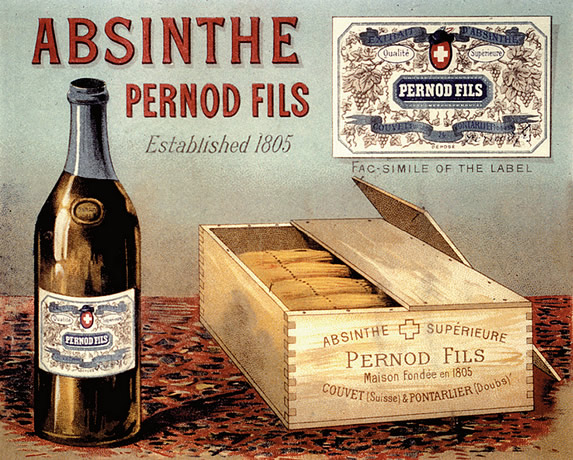
Later, the entrepreneur Henri Dubier bought a secret recipe for the drink and set up its mass production with the help of his friend Henri-Louis Pernod in 1798.
The sale of absinthe went well, which necessitated the opening of a new plant in Pontarlier in 1805, which later became the main center of production of the drink, the plant was called "Pernod".
Therefore, very often, when people talk about absinthe, this brand is the first to come to mind, and I consider it the "father of all absinthe".
The popularity of absinthe increased dramatically during the French colonial wars in North Africa, which began in 1830 and peaked in 1844-1847.
The French military was given a certain amount of absinthe to prevent malaria, dysentery and other diseases, as well as to disinfect drinking water. Absinthe proved so effective that it became a part of French army life from Madagascar to Indochina.
At the same time, cases of paranoid schizophrenia, called "le cafard", became more and more common in North African troops.
Among the French colonists and emigrants in Algeria, the fashion for absinthe also spread.
In 1888, absinthe was widespread in France. The popularity of absinthe in France was equal to that of wine.
The New York Times noted that in France, girls aged 18 to 20 suffer from liver cirrhosis much more often than in other countries, and the reason is addiction to absinthe. This fascination was explained by the special taste of women for absinthe. They drank it more often undiluted because they did not want to drink too much because of their corset.
Connoisseurs argued that even white wine might seem unclean in taste after absinthe. Absinthe has a special flavor, like menthol cigarettes.

Soldiers returning from the war could no longer give up their absinthe habit, and soon it became a fashionable drink everywhere, especially in Paris.
Since then, absinthe has become an almost mystical drink - it stimulated the creative activity of the Parisian bohemians, relieved the tension and fatigue of the working class, pleasantly refreshed respectable bourgeois on hot summer days, and even ignited love. As a result, the time from 5 to 7 p.m. in Paris was called "l'heure verte," which means "green time" in French. It was at this time that an almost sacred ritual, entirely dedicated to absinthe, took place.

Over time, absinthe was "baptized" and in 1860, absinthe began to descend from bohemian heights to the level of ordinary workers.
At its best, absinthe was a rather expensive drink, produced on the basis of wine alcohol, but with the advent of cheap brands based on ordinary alcohol, it became much more affordable and harmful.
Most of these absinthes were not distilled and were particularly bitter.
Since 1880, absinthe has been strongly associated with schizophrenia, suffering, and death. It was called "madness in a bottle" (French. la folie en bouteille).
Consumption of the drink grew every year, if in 1874 it amounted to 700,000 liters per year, then by 1910 it was already 36,000,000,000 liters. No wonder absinthe had more and more opponents.
Another reason for the use of absinthe by the working class was the desire to get closer to the sublime and beautiful feeling that the "bohemians of Paris" were rumored to experience.
Everyone is famous poets, writers, artists of that time were delighted with the "green fairy" ("la fée ferte").
Persecution and prohibition
In July 1905, Gene Landfrey, a Swiss farmer, under the influence of a large number of different alcoholic beverages, drank a glass of absinthe and shot his entire family - the farmer's consumption of mint liqueur, a glass of cognac, two cups of coffee with cognac, and three liters of wine on the same day did not find such an enthusiastic response from newspaper reporters.
This story made the front pages of European newspapers, resulting in 82,450 people signing a petition to the authorities to ban absinthe in Switzerland (the petition was granted in early 1906).

In March 1915, with the support of the so-called "wine lobby," France banned not only the sale but also the production of absinthe.
Even earlier, in 1912, the US Senate voted to ban "all beverages containing thujone" (in the 1980s, this law was supplemented by another one, according to which US military personnel were prohibited from drinking absinthe even abroad).
In the end, absinthe was actually banned from many countries around the world: Switzerland, the USA, France, Belgium, Italy, Bulgaria, Germany. Absinthe began to be called a drug.
From the 1930s to the late 1980s, absinthe existed on a semi-legal basis (mostly pre-war stocks and smuggled supplies from England were destroyed), or in the form of substitutes: anise vodka, wormwood leaves soaked in vodka, etc. п.
8 recipes for absinthe at home.
Revival
The place where absinthe was revived is considered to be Great Britain, or rather Scotland, where it was never banned, but even after persecution in other countries, it was not popular at all until 1998, when the Czech brand Hill's, founded in 1920, launched the drink on the British market.
Celebrities contributed to the success of this enterprise in no small measure, in particular, Johnny Depp, who, while in the UK filming the movie Sleepy Hollow, recounted how he got drunk on absinthe with Hunter S. Thompson on the set of "Fear and Loathing in Las Vegas".

Later, this fashion was picked up overseas, and many celebrities could be seen drinking absinthe: from Eminem to Marilyn Manson.
In general, the success of the Czech brand is difficult to explain because the taste of this absinthe was disgusting. "This absinthe is drunk to get drunk quickly; only a masochist adds water to it to prolong its effect.". Good absinthe, on the other hand, can be drunk slowly and for a long time.
The Hills were scolded by all the experts and a year later, with the assistance of the main French absinthe expert and founder of the absinthe museum, Marie-Claude Delaye, they released a new brand "La Fee", which could be tasted...
The manufacturer's marketing policy took into account the comic attitude of the British to the "most dangerous of poisons", a number of promotions had a pronounced "frivolous" character, not typical of alcohol promotion.
This led to the creation of a positive image of absinthe - a little funny and slightly sinister - never before had absinthe had such a "rosy" reputation.
In 2004, the Swiss parliament voted to legalize absinthe, which had been banned since 1907.
On July 24, 2004, the Amsterdam court invalidated the Dutch law of 1909 banning absinthe.
Currently, absinthe producers are obliged to comply with the restrictions imposed by the European Union, according to which the amount of thujone in absinthe should not exceed 10 mg/liter.
At the same time, some European countries produce absinthe with a thujone content of 35 mg/liter.
Update: 19.04.2016
Category: Absinthe