Valpolicella wines: history, overview, what they are made of, types

The Valpolicella wine-growing area is located in the north-east of Italy, in the west of the famous Veneto region. The region is famous for marble quarrying and production of luxury wines. The name of the area, which translates as "the valley of a thousand cellars", indicates how much attention is paid to the creation of grape drinks in the region.
The wines produced here belong to the categories DOC and DOCG - the highest in Italian winemaking.
Wine history of Valpolicella
Archaeological finds show that wine production in the region began in the first and second millennia. c. to n.е. э., and the first written mention of their sale dates back to the VI century. е. э.
The quality of alcoholic beverages from Valpolicella was already decent, which allowed it to take a significant share in the trade of the Venetian Republic by the eighth century.
During the Middle Ages, local wines lost some popularity, giving way to Greek wines. It was possible to restore the previous level of sales only in the XV-XVI centuries: during this period, Valpolicella products spread throughout Europe.
Another decline was outlined in the XIX century, when the region was raging epidemic of phylloxera and civil strife. To restore the vineyards and peace in the neighborhood
It took many years for Valpolicella to revive: local winemaking was not revived until the middle of the XX century. During this period, the "amarone" technology, which involves the production of wine from rancid fruits, became particularly widespread. Around the same time, the region expanded its territory and gained the status of a DOC.
However, the pursuit of profit led to a deterioration in the quality of local wines and, as a result, to a decline in sales. The 70s and 80s of the XX century were particularly unsuccessful in this regard.
It was possible to restore the lost reputation by the early 90s: the winemakers of Valpolicella again focused on the "amarone" method.
As a result, sales volumes have doubled and prices have increased 3 times. In the early 2000s, the region's hotel wines were awarded a new status - the highest in Italian winemaking DOCG.

Popular varieties
The region is home to mostly indigenous red varieties, which are practically not cultivated elsewhere.
Corvina
The main grape is Corvina, which has a high tannin content. The share of the variety in Valpolicella drinks is from 40 to 70%.
Dark berries with thick skin give the wines a recognizable cherry aroma, bright ruby color and a strong bouquet.
Sun-dried fruits are used in the Rechto and Amarone technologies.
Rondinella
Another common variety that reaches 40% in local wines is Rondinella.
The fruits are brightly colored in blue-purple, covered with a dense coating and are especially aromatic.
They give a soft cherry accent and a rich ruby hue to the wine bouquet.
Molinara
The third most important variety - Molinara - has high acidity and a variable taste with berry notes. Its content in Valpolicella wines is from 5 to 25%.
The name of the wine (in Persian. "miller") the variety was named for the generous, flour-like coating on the skin of red-violet fruits.
The wines from it are light, lively, with raspberry and cherry tones.
In addition to these grape varieties, the region also grows traditional Italian Sangiovese, Barbera, Negrara, Rosignola, Trentina, the share of which in beverages does not exceed 15%.
Significant plantations are devoted to the autochthonous Oseleta variety and the Novelo variety, similar to the French Beaujolais.
Types of Valpolicella
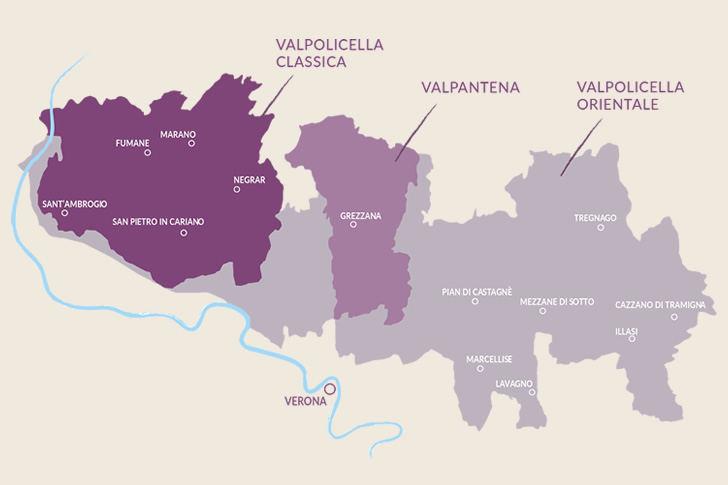
Depending on the province of production, local beverages are divided into:
-
Valpolicella Classico wines produced in the oldest communes of the region.
-
Wines of Valpantena, produced in the valley of the same name.
Products controlled by origin (DOC) include Valpolicella, Valpolicella Superiore, Recioto and Amarone.
Of particular interest are beverages made from fermented grapes using the Rechto, Amarone and Ripasso technologies. The first two are collectively called Passito, and the process of drying is called appassimento.
The method involves drying fruits harvested at a high degree of maturity for several weeks or even months. Loss of moisture leads to an increase in the level of sugars and flavor components.
As a result, the wine is concentrated and strong. Fermented dried fruit cake is reused in the production of ordinary Valpolicella wines.
The technology of secondary processing is called Ripasso. Such drinks are characterized by less complexity and depth, but significantly reduce production costs.
Basic wines of Valpolicella
They are characterized by a beautiful ruby color that turns into garnet over time. The soft bouquet, in addition to cherry hues, contains delicate almond tones with a bitter aftertaste, notes of banana and blueberry.
The harmonious taste is characterized by increased softness, velvety, and fullness. These drinks are often compared to French Beaujolais wines. Valpolicella superiore wines
Fermented for 14 months or more. For their production, fruits slightly dried on the vine with a high level of alcohol content (not lower than 11°), which reaches 12° in the finished drink, are used.

Wines of Rechto
Can be still or sparkling. The former are characterized by a delicate pomegranate hue, a fresh bouquet with floral tones.
The aroma has notes of spicy cherry, iris, violet, rose, tobacco.
The taste is dominated by juicy fruit accents with tones of honey and candied chestnuts. Strength often exceeds 14°.
Sparkling wines are characterized by a noble ruby color and a delicate, sweet, lively taste.
Amarone wines
Unlike Recchio, the Amarone technology involves the complete fermentation of sugars accumulated in the fermented fruit. The oldest wine produced by this method is stored in the distilleries of Villa Mosconi: the bottle dates back to 1940.
Amarone labels contain a reference to the region of production: the inscription Classico or Valpantena.
These wines are characterized by a juicy pomegranate-red color, which in aged specimens turns into orange-red, a persistent aroma with cherry-chestnut tones, liveliness and strong tannin...
The taste is powerful, bright, fresh, oily, with accents of chocolate, figs, raisins. Minimum aging period: 2 years, optimal - 4-5 years. Medium strength: 15-18°.
Among the well-known brands in the region:
Allegrini
Domini Veneti
Tommaso Bussola
Stefano Accordini
Masi
Lenotti
Update: 14.11.2019
Category: Wine and Vermouth