Lagavulin whiskey: history, overview of taste and types

Malt beverages from Islay are distinguished from other Scotch scotches by a pronounced "smokiness" and "peatiness" of the bouquet.
Lagavulin whiskey is considered a classic example of local products: smoked notes are heard most clearly in it. Some consumers are scared off by the specific taste, others are attracted to it, but no one is indifferent.
History of Lagavulin whiskey
The first distilleries on the island of Islay appeared in the XVIII century. These were illegal businesses, most of which had to close after the laws were tightened. Until the beginning of the XIX century, only two whiskey distilleries survived on the island. One of them was owned by farmer John Johnston.
In 1816, he registered his company under the name "Lagavulin", thereby launching the legal production of whiskey in the region. Soon, John bought the second surviving distillery from its owner, Archibald Campbell.
After the death of the founder, the company changed hands several times: in the 30s it fell into the hands of the merchant Alexander Graham, and in 1861 it became part of James L Mackie & Co.
The company reached its peak under Peter Mackey, who made the Lagavulin brand famous all over the world. In his work, the "tireless Pete" was guided by the principle "nothing is impossible", which he managed to realize. It was he who created the popular White Horse blended whiskey, based on Lagavulin spirits, and began to use a screw cap to close bottles. Peter also significantly expanded the company's capacity by launching an auxiliary distillery, Malt Mill.
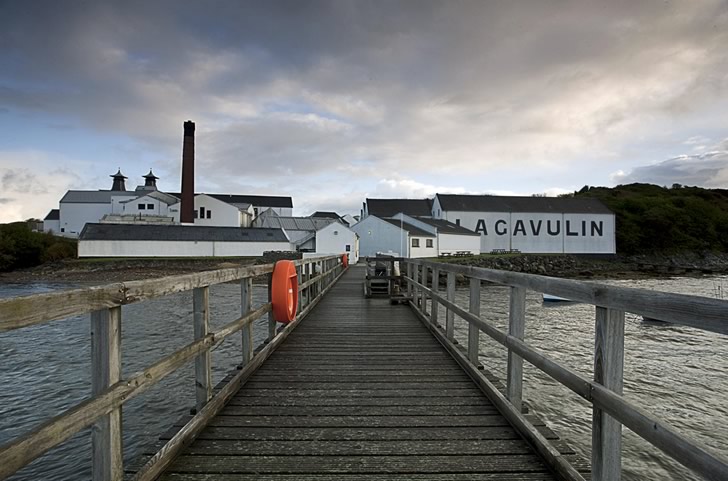
In 1927, the Lagavulin and White Horse brands merged under the banner of the Distillers Company Limited. During the Second World War, the company was forced to close production, which resumed almost immediately after the war ended.
Today, the Lagavulin brand is part of the product portfolio of the alcohol giant Diageo.
Specifics of Lagavulin whiskey production
To create whisky, the manufacturer uses water from local sources Loch Sholum and Loch Lochan.
Malt is purchased from Port Ellen Maltings, where it is made according to a special recipe specifically for Lagavulin. Until 1974, the company harvested barley on its own: it was grown, malted using the traditional "floor" method and ground at its own mill.
For distillation, 4 distillation cubes are used (2 primary and 2 secondary), the design of which allows to obtain the purest and softest alcohols. The capacity of the equipment reaches 2 million liters per year.
For aging, bourbon barrels are used, less often - sherry barrels.
Most of the whiskey is bottled directly at the distillery: a very small percentage of distillates is sold to other companies (for blending).
Types of Lagavulin whiskey
The legendary brand produces single malt beverages of varying degrees of aging. The main collection includes:
Lagavulin 12 years old
Pale golden whiskey with a delicate aroma, in which characteristic smoky notes are combined with accents of toffee and fresh pastries.
Nose: lively, sweet, moderately oily and spicy, with notes of lime, grain, salt, wood and smoked peat.

Lagavulin 16 Year Old
A classic of the genre - one of the most popular scotches of the legendary brand.
The drink has a rich golden amber color with pronounced accents of peat, iodine, sherry and oak.
Finish: bright, sweet, oily, with smoked and marine accents, a pleasant rich lingering finish.
Lagavulin Distillers Edition
A series of drinks that is updated annually with new releases.
Sweet sherry barrels are used for additional aging.
Minimum age of the spirits: 16 years. Shades of peat, sea, dried fruits, honey, oak and malt are traditionally present in each release.
Alcohol content: 43%.


To celebrate the 200th anniversary of the company, Lagavulin 25 Year Old and Lagavulin 8 Year Old were released. Also, the brand's collection periodically includes limited versions of special drinks dedicated to certain events. The strength of scotches varies from 43 to 60%.
Update: 25.04.2019
Category: Whiskey and Bourbon