White Horse whiskey: history, overview of taste and types + how to distinguish a fake

Elite blended whiskey "White horse" - one of the cult spirits of Scotland. It is even called a symbol of this freedom-loving country.
The label with a graceful white horse is well known not only to the inhabitants of the island state, but also to absolutely all whiskey connoisseurs from around the world. The products are especially popular in the USA and Japan.
Due to the bright peat flavor, not every taster is able to drink "White Horse" in its pure form, so the drink is often included in cocktails. Although true connoisseurs say that this is exactly what a real whiskey from the land of kilts and bagpipes should be like.
History of White Horse whiskey
The brand got its noble name from the family inn built in Scotland in 1742. In turn, the drinking establishment was named after the thoroughbred white horses from the royal stable of Mary Stuart.
Business was brisk, visitors were not transferred, but the active entrepreneur wanted to try his hand at a new field. Thus, at the end of the XIX century, the distillery "Mackie and Co", later renamed "White Horse", appeared in the vicinity of Glasgow. It is noteworthy that the number "1742" on the bottles of the famous whiskey does not correspond to the date of the plant's foundation, but to the year the tavern was opened.
James's nephew Peter Mackey was responsible for creating the memorable name and officially registering the brand in 1891. Before the young distiller began to help his uncle promote the brand and improve the drinks produced, he mastered the intricacies of making and selling whiskey at the Lagavulin plant.
By the beginning of the XX century, the management of the company was almost completely in the hands of Peter: he was engaged in marketing, controlled production, participated in the creation of blends, organized export deliveries.
In 1915, the ambitious nephew added to the White Horse's holdings with the successful acquisition of the Craigellachie distillery in Speyside, which, among other plants, supplied spirits for the creation of the legendary drink. It is believed that the idea of using a screw cap to seal the bottles also came from Peter. In any case, the innovation was born at the White Horse distillery. Before that, Scotch whisky was corked with a regular cork like wine.
In 1900, the brand's drinks were first sold outside the country. On the occasion of this momentous event, which coincided with the beautiful date of the end of the century, a special blend "White Horse 1900" was released. You can try it today. In 1927, a few years after the death of Peter Mackey, the company became part of The Distillers Compagny Limited, and in the 2000s it became the property of the alcohol giant Diageo.
Today, White horse drinks are known all over the world not only as a great blended malt product, but also as the most counterfeit whiskey. No wonder, considering the popularity of.
Overview of taste and types
Each product of the brand is a harmonious blend of several dozen malt and grain spirits. The share of the former is about 30%, the rest falls on the grain part.
The main component of the White Horse is Lagavulin whiskey from the Isle of Islay, which gives the drink a bitter smoky peat flavor and iodine-salt notes.
It also includes Talisker, Saol Ila, Craigellachie, Glen Elgin, Linkwood spirits.
It is noteworthy that the recipe of the blends has not changed since its creation in the XIX century. Aging in sherry barrels is also mandatory.
The brand's collection consists of 4 permanent drinks:
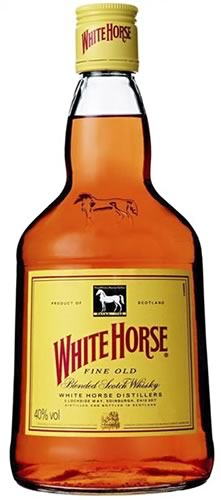
White Horse Fine Old
The most common and popular product of the company, developed by Peter Mackey in 1891.
Consists of 35 varieties of whiskey. It has a brilliant golden amber color, characteristic peat and woody hues, and a long honey-caramel aftertaste.

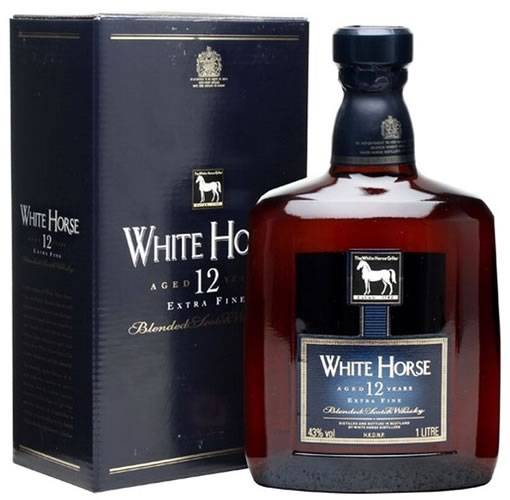
White Horse Extra Fine
A dark amber whiskey that has been aged for 12 years, thanks to which notes of dried fruits and spices have appeared in the sweetish-smoky taste of the tart spirit.
The bouquet is dominated by hints of prunes and figs. The refreshing aftertaste plays with spicy accents of cinnamon and ginger.
White Horse 1900
A festive drink of amber and nutty hue with the aroma of sweet flowers, refreshing woody-fruity flavor and citrus and nutty aftertaste. The characteristic tones of smoke, peat and honey are also present.
White Horse Logan
The rarest version of the product, which was named in honor of the founder of the brand. It appears on sale infrequently and is more expensive than other blends.
Consists of 50 varieties of whiskey, aged for at least 12 years. In the taste, in addition to bright peat and smoke notes, there are hints of fruit and sherry.


You can taste real Scotch whiskey in its pure form or as part of cocktails. Ladies prefer to dilute rough alcohol with cherry and apple juices, Campari liqueur. Men drink White Horse with ice, cigar or coffee.
How to distinguish a fake White Horse whiskey
In order not to become the owner of a counterfeit, you need to carefully study the future purchase. White Horse whiskey is produced only in four traditional variants (listed above), the brand has no other products.
The drink is packaged in a box, it should be made of thick, high-quality cardboard with neatly applied bright inscriptions, partially embossed. The same goes for the label: no mistakes, jumping letters, hardly visible words, glue marks, crooked edges.
The bottle of original whiskey must have the following markings:
In the upper front part, there is a convex, clear image of a horse with clearly visible details.
In the lower part on the back, right on the glass - engraving with the date of bottling and serial number.
Metal lid with the brand logo (a white horse in a black square) on the top and the brand name "White Horse" on the side.
When shaken, large stable bubbles are formed in a high-quality drink. The consistency is oily, the whiskey flows slowly down the glass. The color is amber, without signs of turbidity and sediment. It is best to buy the drink in specialized outlets.
Update: 26.03.2019
Category: Whiskey and Bourbon