Ballantyne's whiskey: an overview, how to distinguish a fake, what to drink, types
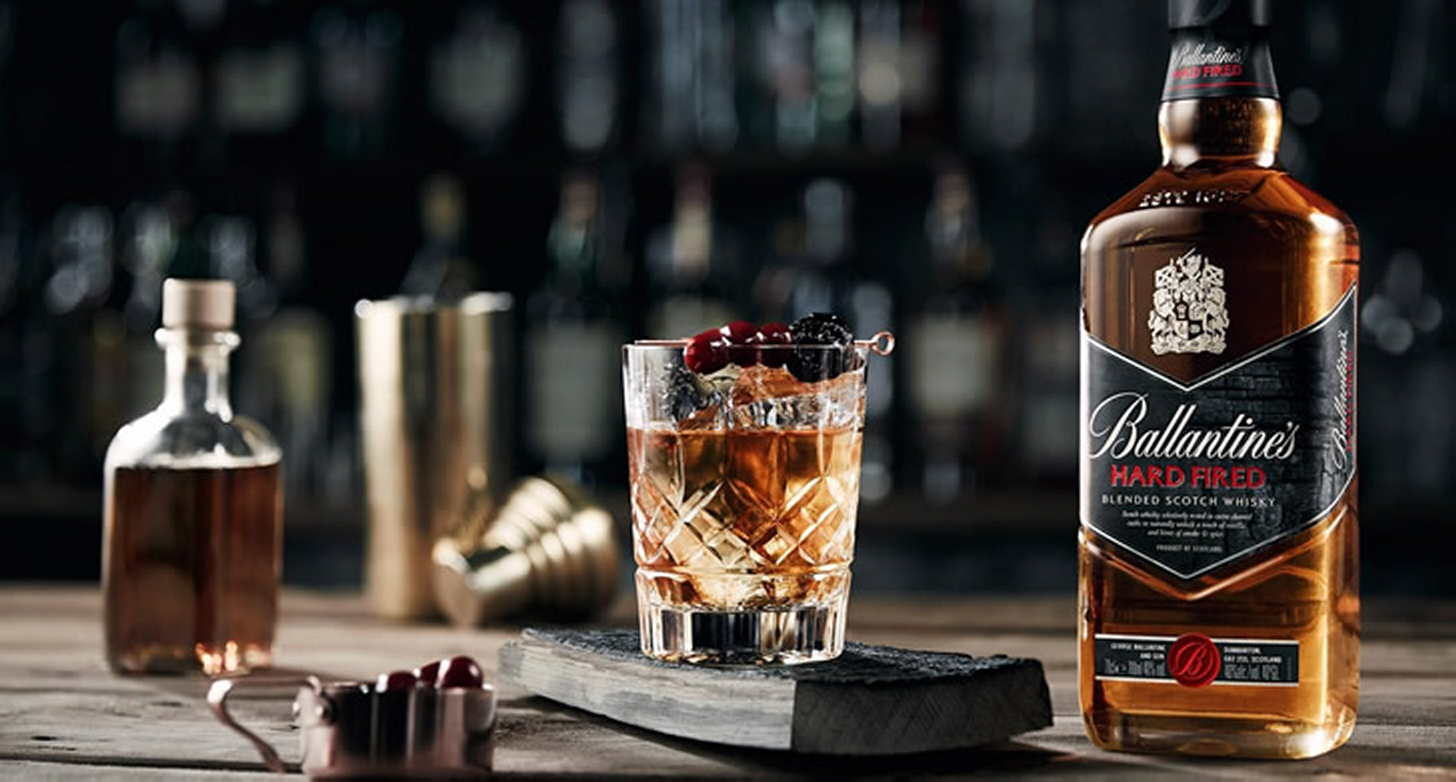
Ballantine's Scotch whiskey (Ballantine’s) - perhaps the best option for a debut in terms of using many favorite and respected smoke scotches.
Description of Ballantines whiskey
If you don't want to find yourself in an awkward situation, never say the phrase: "Ballantines single malt whiskey". Such a drink simply does not exist. In our case, we can only talk about blends. The composition of Ballantines whiskey includes more than sixty malt and grain spirits of different aging. These are "representatives" of four of the five whiskey distilling regions of Scotland: Highland, Lowland, Speyside and Islay. A special place in this range is occupied by truly single malt drinks: Glenburgie, Miltonduff and Glentauchers, which are added to Ballantine's blends accordingly’s sweetness, richness and long aftertaste.
The aging of Ballantine's whiskeys ranges from 3 to 40 years. The strength of brand representatives ranges from 35-43 degrees. For example, Ballantyne's Hard Fire, Ballantyne's 12 Years, or the famous Ballantyne's Fine whiskey contain 40% alcohol. For their part, Ballantine's 17 Year Old, Ballantine's 21 Year Old and the more aged drinks in this series boast 43-degree strength. But the strength of Ballantyne's Brazil, which somewhat deviates from the original traditions of whiskey distilling, is only 35 degrees.
Ballantyne whiskey: the manufacturer
The creator of the brand was a descendant of Scottish farmers - George Ballantine, who founded Ballantine and Son Ltd in 1869. In 1919, the business was bought out by the Ballantines' junior partners - Barclay and McKinlay. Subsequently, the brand, which gained worldwide fame, changed hands several times until it finally became the property of the French alcohol giant Pernod Ricard in 2005.
At the same time, it is interesting to note that since the mid-60s of the last century, the owners of the brand have refused to compete in the British market and shifted their attention to the countries of Southern Europe, and then to the Far East, Southeast Asia and even Latin America...

Types of Ballantine's whiskey
For 2017, the Ballantine line’s whiskey range includes 9 varieties:
Ballantine’s Finest
A three-year aged drink that was created in 1910. Possesses a light golden color; notes of spices and heather honey in the aroma; Hints of milk chocolate, red apples and vanilla in the taste and fresh aftertaste with floral hints.
Ballantine’s Hard Fired
The whiskey is aged for three years in twice-fired white American oak barrels. It has an amber-golden color; contains a hint of ripe fruit and creamy toffee in its aroma; also has honey-liquorice notes in the taste and a long vanilla aftertaste.
Ballantine's Brasil
An experimental three-year old drink, one of the spirits of which is infused with Brazilian lime peel before becoming part of the blend. It is characterized by a rich golden color, lime-vanilla leitmotif in taste and aroma, as well as lime notes in the aftertaste, which slowly fades away.
Ballantine's 12 Years
Blend of honey-golden color. The taste and aroma of this partly ladies' drink is dominated by creamy honey sweetness with floral and vanilla undertones. According to some connoisseurs, salty notes can be detected in the aftertaste, although the manufacturer does not say anything about this possibility.
Ballantine's 17 Years
The drink has a deep amber-golden color. Its rich honey-creamy taste with spicy liquorice interspersed with woody vanilla aroma and a long, slightly spicy aftertaste.
Ballantine's 21 Years
Red gold-colored whiskey aged in sherry casks. It has an aroma rich in apple, floral and honey motifs. Its rich, rounded taste, endowed with raisin-marmalade and marshmallow-liquorice hints, ends with a long aftertaste that brings to mind dried fruits.
Ballantine's Limited
A dark golden drink produced in small batches and containing rare malt distillates refined by many years of aging. The aroma clearly reveals notes of creamy toffee, pear, orange and oriental spices. The taste is full of unambiguous hints of peaches, pears and vanilla. All this ends with a persistent multifaceted aftertaste.
Ballantine's 30 Years
Aristocrat of the color of old gold. It contains spirits once produced at long-closed distilleries. You understand that such a term is able to refine even the most unpretentious blend, deepening and expanding its flavor and aroma range to the fullest extent.
Ballantine's 40 years
A drink that resembles molten gold in color. This whiskey has mixed and intertwined all the traditional organoleptics for Ballantyne's drinks beyond recognition, which allows you to meditate over a glass for hours, discovering new sensations.
What and how to drink Ballantyne's
The scotch we are interested in, like all drinks of this kind, is not a table scotch. Therefore, it will be right to drink Ballantyne's whiskey without accompanying it with any snacks.
Three-year-old brands can be consumed over ice or soda as an aperitif, as well as used in mixes and cocktails appropriate for the occasion. More aged versions are served neat after a meal in traditional rocks, filled no more than a third. The temperature of the drink should remain between 17-18 °C.
How to distinguish a fake Ballantine's
Ballantine is the most commonly counterfeited brand’s Finest. Nevertheless, other relatively inexpensive and therefore most common representatives of the line often suffer the same fate. At the same time, there are ways to minimize the risk when buying this drink.
First of all, we are talking about things related to basic common sense:
Choosing a trustworthy supermarket;
Rejection of suspiciously cheap drinks;
Pay attention to the quality and competent execution of the label, the correctness of the barcode of the country of origin (in our case, the UK, the first 50 digits) and the proper condition of the excise stamp.
At the same time, it should be borne in mind that the manufacturers themselves have tried to take measures to allow the buyer to determine the difference between an authentic product and an average fake:
On the bottom of the bottle there is an expressive neatly executed engraving "Ballantine’s";
Two similar inscriptions are placed on the walls of the vessel;
In the middle of the lid, which is in no way plastic, is a Latin letter "B" framed by a circular inscription: "George Ballantine and Son Ltd."," George Ballantine and Son Ltd. Distillers Dumbarton Scotland".
We hope that getting to know Scotch smoky whisky with the help of Ballantine’s will not deceive your expectations.
Update: 25.12.2017
Category: Whiskey and Bourbon